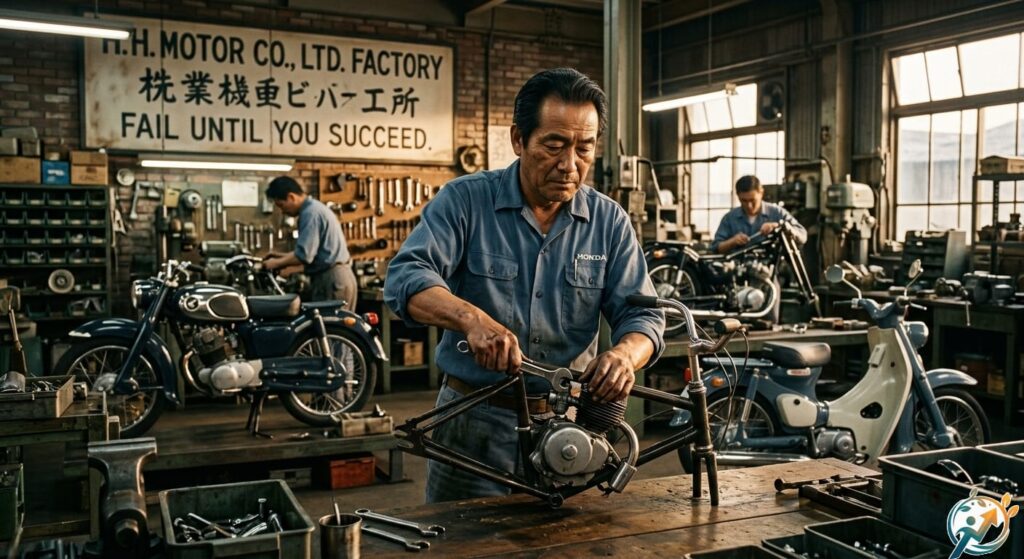

Success is often built on the ruins of failure. While the name Honda today signifies global excellence, the journey of its founder, Soichiro Honda, was a brutal cycle of rejection, poverty, and disaster. His life is the ultimate blueprint for anyone who feels that their current failures are final
A Passion Born in Grease
Soichiro Honda was born in 1906 in a rural Japanese village. Unlike his peers, he wasn’t interested in books; he was captivated by the mechanical pulse of his father’s bicycle repair shop. When he saw a car for the first time, the young enthusiast didn’t just see a vehicle; he saw a miracle of engineering.
At the age of 15, he left for Tokyo with no formal education to work as an apprentice. He spent six years mastering the art of mechanics, often working in freezing conditions, driven by a singular obsession: to build the perfect engine for the future of Honda.
The Piston Ring Failure: A Lesson in Quality
In 1937, he invested everything he owned into a small workshop called Tokai Seiki. His goal was to mass-produce piston rings for Toyota. He worked tirelessly, often sleeping on his workshop floor, convinced that this contract would secure the future of his early Honda ventures.
The result? Total failure. Toyota rejected his first batch because they didn’t meet quality standards. Instead of blaming the client, he realized his technical knowledge was lacking. He went back to school for two years, where he was mocked as a “failed businessman.”
Soichiro Honda passed away in 1991, but his legacy is visible on every road. He didn’t build a billion-dollar company because he was lucky; he built it because he was willing to fail more times than anyone else.
“Many people dream of success. To me, success can only be achieved through repeated failure,” he once remarked.
The Soichiro Honda Journey Through War
By 1939, he finally won the Toyota contract. However, World War II broke out, and his factories were hit by Allied bombers. He didn’t give up. He used the scrap metal from unexploded bombs to rebuild his production line. But just as he restarted, the 1945 Mikawa earthquake leveled his factories. In an instant, his life’s work was turned into rubble. He sold the remains to Toyota and started over.
The Motorized Bicycle: A Post-War Pivot
Post-war Japan was in ruins. Public transport was destroyed, and fuel was scarce. While others saw despair, the founder of Honda saw a logistics problem. He found surplus radio generator engines and attached them to bicycles. This was the birth of the first Honda motorized vehicle.
In 1948, he teamed up with Takeo Fujisawa. Together, they founded Honda Motor Co. with a vision to mobilize the masses. You can read more about their early engineering marvels on the official Honda history page.
Why Honda Conquered the American Market
In 1959, the company entered the U.S. market. At the time, Americans only bought heavy motorcycles. The Japanese bikes were seen as toys. The first year was a disaster; the bikes overheated on long highways.
The Marketing Revolution
Instead of fighting the “tough biker” image, they marketed the Super Cub to ordinary people. The famous campaign “You meet the nicest people on a Honda” changed everything. By 1963, they were the top-selling brand in the U.S. For more success stories like this, check our entrepreneurship section.
Defying the Government: The Birth of the Civic
In the 1960s, the Japanese government tried to stop the company from building cars. They ignored the decree. He applied his motorcycle expertise to create the Honda Civic. When the 1970s oil crisis hit, the world wanted fuel-efficient cars, and the *Honda brand was ready to lead.
Key Lessons from the Honda Success Story
- Failure is Tuition: Every mistake is a payment towards success.
- Adaptability is Survival: When piston rings failed, he studied; when big bikes failed, he sold small ones.
- Vision Over Validation: Never wait for “experts” to tell you that you are ready.
The Unstoppable Dreamer
Soichiro Honda passed away in 1991, but his legacy is visible on every road. He didn’t build a billion-dollar company because he was lucky; he built it because he was willing to fail more times than anyone else.