
A Drop of Oil That Changed the World
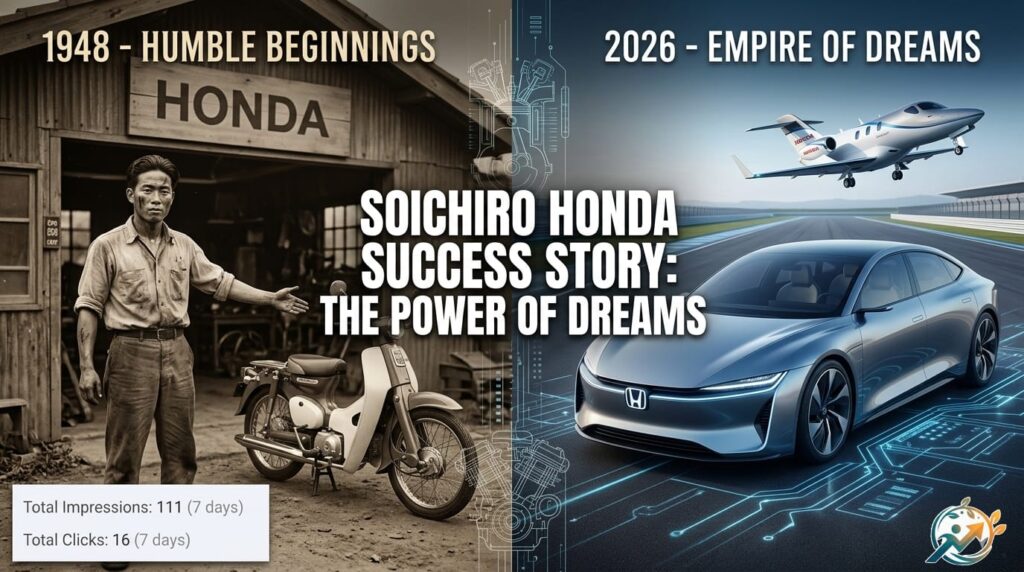
The Success Story of Soichiro Honda stands as a testament to the power of resilience in the engineering world. In the realm of engineering, great stories don’t always begin in sterile laboratories or glass-walled boardrooms. Sometimes, they start with the smell of grease and a drop of oil on the clothes of a young boy watching his father repair bicycles in a rural workshop. That boy was Soichiro Honda—a man who didn’t just build a car company, but established a technological philosophy that continues to resonate globally in 2026.
As developers, coders, and geopolitical analysts navigate the digital complexities of today, Honda’s journey stands as a masterclass in the “Algorithm of Persistence.” It is a story of failure transformed into fuel, and engineering that transcends metal to become a vision for the future.
I. The Toyota Rejection: When Failure Becomes the Gateway to Glory
In 1937, Honda founded Tokai Seiki to manufacture piston rings, aiming to supply the automotive giant, Toyota. Soichiro spent sleepless nights in his workshop, even pawning his wife’s jewelry to fund his research. Finally, when he presented his samples, Toyota’s verdict was devastating: “Rejected. Your product does not meet our standards.”
Instead of surrendering, Honda returned to school at the age of 30. He didn’t care about a degree; he wanted the “Technical Knowledge” he lacked in metallurgy. After two years of refining his mechanical algorithms and correcting production errors, he finally won the contract.
The Lesson for 2026 Developers:
Failing to pass the “first test”—whether it’s a code review or a business pitch—is not the end of the road. It is a clear signal of a “Bug” in the system that requires an upgrade.
II. Rebuilding from the Rubble: The Geopolitical Logic of Engineering
Post-World War II, Japan was a nation in ruins. Bombs destroyed Honda’s factories, and an earthquake leveled what remained. Honda found himself without a factory and without capital. However, he possessed the world’s greatest algorithm: The ability to identify a need.
He observed people struggling to commute in a devastated country with scarce fuel. He struck upon a brilliant idea: repurposing small surplus generator engines from the war and mounting them onto ordinary bicycles. Thus, the “Super Cub” was born. It didn’t just save Honda’s company; it revitalized Japan’s economy and provided affordable mobility to millions.
This pivot proves that innovation isn’t always about inventing something “complex,” but about finding “smart and simple” solutions to complex problems—a principle we see today in the hybrid-casual games dominating the app stores.
III. The Philosophy of “The Power of Dreams”
Honda’s slogan, “The Power of Dreams,” wasn’t mere marketing fluff. For Soichiro, a dream was a continuous laboratory experiment. He entered Formula 1 and the Isle of Man TT when the West mocked Japanese industry. He famously said: “If we don’t compete with the best in the world, we will never be the best.”
In the 1970s, the automotive world faced the “Clean Air Act” crisis. While giants like GM and Ford struggled, Honda’s young engineering team developed the CVCC engine. It was a technical miracle; it burned clean enough to pass strict US emissions standards without a costly catalytic converter. Honda proved that “Engineering Excellence” can shatter global monopolies.
IV. Soichiro Honda in 2026: AI and the Future
If Soichiro Honda were alive in 2026, he would be at the forefront success story of integrating Artificial Intelligence (AI) into powertrain development. Today, his legacy lives on in Honda’s shift toward Electric Vehicles (EVs) and the development of the HondaJet, the most efficient aircraft in its class.
At AmalImpact, our analysis of 2026 geopolitical trends aligns perfectly with Honda’s vision. The world today doesn’t just need machines; it needs “Smart Systems” that respect the environment while enhancing human life. Honda wasn’t selling steel; he was selling the “Freedom of Mobility.”
V. 10 Golden Rules for Success Story in the Digital Age
- Failure is Your Greatest Teacher: Success represents 1% of your work, resulting from the 99% that is called failure.
- Break Old Rules: If the rules prevent innovation, change the rules.
- Genba (Fieldwork): Honda hated offices; he was always on the factory floor. (Advice for developers: Stay close to the user experience).
- Empower the Youth: He hired young engineers because they “did not know what was impossible.”
- Competition is Fuel: Without strong rivals, you become slow.
- Quality Over Profit: If you build an excellent product, money will chase you.
- Speed in Adaptation: Just as he pivoted war engines to bicycles, pivot your skills for the 2026 market.
- The World is Your Playground: Honda targeted the global market from day one.
- Technical Humility: Stay a student; knowledge doesn’t end with a degree.
- Enjoy the Grind: If you don’t love what you do, you won’t excel.
VI. Honda and Geopolitics: A Silent Global Conquest
In the 60s and 70s, there was significant geopolitical friction regarding Japan’s economic rise. Honda followed a clever strategy: instead of just exporting, he built factories in the US and Europe. He hired local workers and became part of their economic fabric.
This “Economic Diplomacy” is what we need in 2026 to understand the interaction between major powers (China, Russia, USA). Technology is not just a weapon; it is a bridge for communication and soft power.
VII. Start Your Success Story to Own Your Workshop Today
Whether you are building a React application, writing analytical articles, or developing games, remember that Soichiro Honda started by pawning his wife’s jewelry and working in a ruined shed. He had nothing but a dream and a wrench.
In 2026, the opportunities provided by the Internet and AI far exceed what Honda had. The only barrier is the “Fear of Failure.” Make your digital story a version of Honda’s: start small, learn from rejection, and don’t stop until the world recognizes your brand.
This article was crafted to be an inspiring reference success story for anyone seeking to understand the intersection of technology, history, and personal success in the world of 2026.