On the morning of February 28, 2026, the geopolitical landscape of the Middle East was irrevocably altered. A massive, coordinated military campaign launched by U.S. and Israeli forces targeted strategic assets across Iran. Marking the beginning of a conflict that many had feared for decades. While the immediate strikes aimed at neutralizing Iran’s nuclear capabilities and military command. The ripples of this explosion have traveled far beyond the borders of the Islamic Republic. Dismantling old alliances and forging a chaotic new reality.
This was not merely a regional skirmish. It was the “logical culmination” of years of failed diplomacy and escalating tensions. That reached a breaking point in early 2026. As we look back from the perspective of a world still reeling from the shockwaves. We must analyze not just the war itself. But the profound global transformation it triggered.
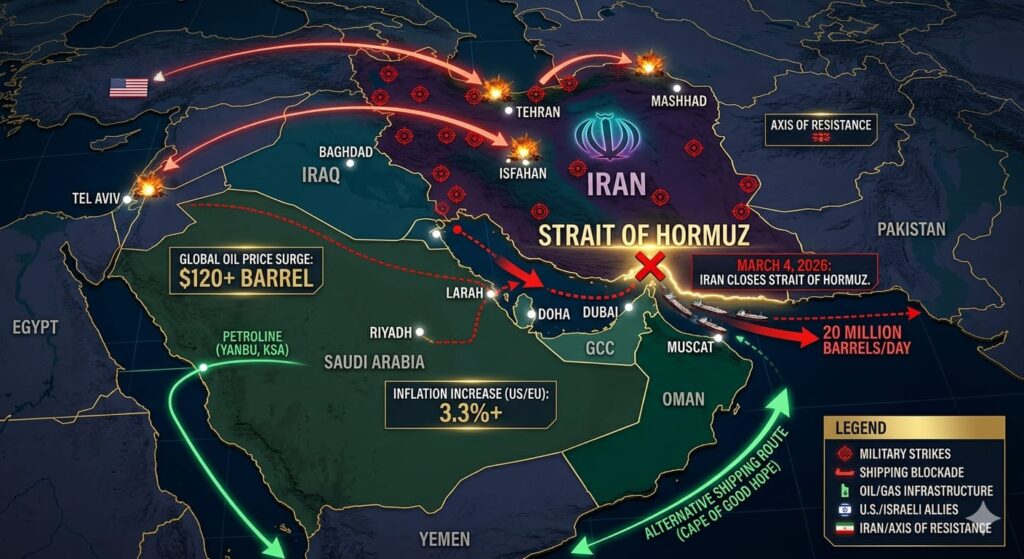
The Strategic Architecture of the Conflict: The Economic Consequences of Iran War 2026
The conflict was precipitated by several key factors. Following the return of “maximum pressure” policies in 2025. Tensions between Tehran and the West reached an all-time high.
By early 2026, intelligence reports suggested that Iran was within weeks of completing a nuclear device, prompting a pre-emptive strike by the U.S. and Israel.
The initial phase of the war saw the decapitation of Iran’s senior leadership, including the reported death of Ayatollah Ali Khamenei.
However, what was intended to be a surgical strike quickly evolved into a broader regional conflagration.
Iran responded by mobilizing its “Axis of Resistance,” launching missile strikes against U.S. bases and targeting critical energy infrastructure in the Gulf.
Economic Shockwaves: The Energy Crisis of the Century
The most immediate and painful consequence for the rest of the world was the weaponization of energy.
Iran’s closure of the Strait of Hormuz—a chokepoint through which 20% of the world’s oil and significant LNG volumes transit—led to the “largest supply disruption in the history of the global oil market”.
- Skyrocketing Prices: Brent crude, which hovered around $70 before the war, spiked past $110, hitting as high as $120 per barrel in March 2026.
- Global Inflation: In the United States, petrol prices surged to over $4 per gallon, driving inflation to 3.3%, its highest in two years.
- Industrial Strain in Europe: Europe, heavily dependent on energy imports, faced a severe supply shock. With the European Central Bank warning of a prolonged period of “stagflation”—low growth combined with high inflation.
The strike on Qatar’s Ras Laffan LNG complex alone knocked out 17% of that country’s export capacity, further squeezing global gas markets.
The Human and Social Cost
Inside Iran, the war triggered a domestic collapse. The Iranian rial plummeted, losing nearly 30% of its value in a matter of weeks. Which ignited the largest protests since the 1979 revolution.
While some Western leaders hoped for a democratic transition, the reality proved far more chaotic.
The country faced the threat of a civil war, with various IRGC factions and ethnic groups vying for control amidst a leadership vacuum.
Regionally, the conflict displaced thousands and created new refugee flows, echoing the tragedies of Syria and Iraq. The “shadow war” that had been fought in the dark for decades was now a blinding, destructive reality for millions of civilians.
A Shift in Global Power Dynamics
Perhaps the most lasting legacy of the 2026 war : Is the end of the era of undisputed American leadership in the Middle East. While the U.S. Proved its military might, it simultaneously demonstrated an inability to fully protect its Gulf allies from Iranian asymmetric retaliation.
1. The Fragility of the Abraham Accords:
The model of Israeli regional integration, which had been gaining momentum, was shattered. Domestic resistance within Arab nations grew, making security ties with Israel politically untenable.
2. The Rise of Alternative Alliances:
With the U.S. distracted by the Iranian quagmire, powers like China and Russia found opportunities to deepen their influence, offering “mediation” and economic lifelines to a region wary of Western-led wars.
3. The New Face of Warfare:
The war validated the effectiveness of ballistic missiles and cheap drone swarms. Even with superior air defenses, the volume of Iranian attacks paralyzed daily life in the Gulf. Proving that conventional military superiority no longer guarantees security.
Conclusion: The Long Road Ahead
The war on Iran in 2026 did not “solve” the Iranian problem. It simply transformed it into a new, more unpredictable set of challenges. The Islamic Republic, though battered and leadership-depleted, has shown a resilient ability to survive through asymmetric means and internal security.
As the global economy slowly adjusts to higher energy costs and the Middle East grapples with a power vacuum. One thing is certain: the old status quo is gone forever. The world has entered a “kaleidoscope” phase where regional pieces are tumbling with no clear center of power. The lesson of 2026 is that in the modern interconnected world, a war in the heart of the energy corridor is a war against global stability itself.
As we monitor the Iran War 2026 developments, the global market remains on edge.“