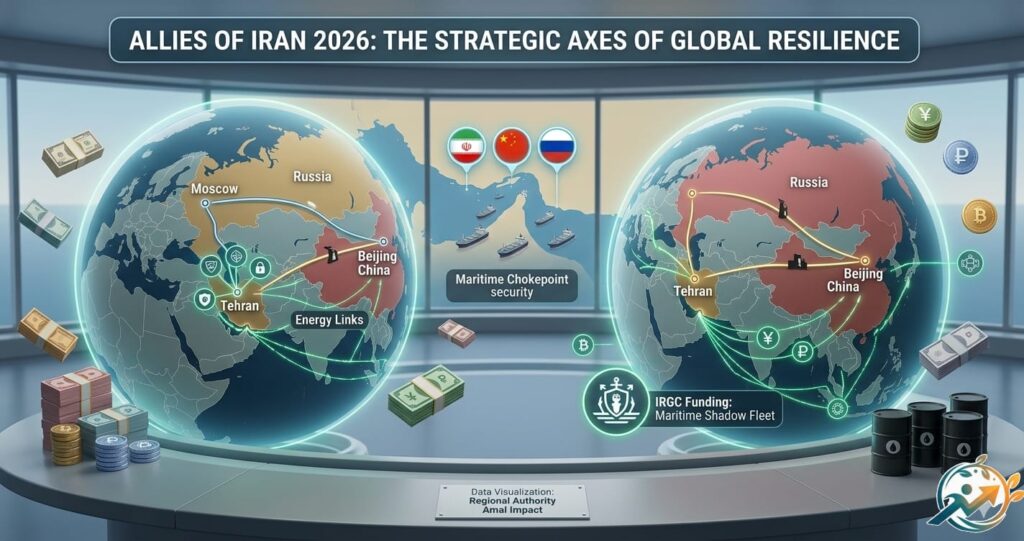

As we move through the middle of this decade, a singular question has come to dominate the discourse of global intelligence and economic forecasting: “Who are the strategic Allies of Iran in 2026?” This is no longer a peripheral concern for regional analysts; it is a fundamental pillar of the new, multipolar world order. In 2026, Tehran has successfully transitioned from a state of enforced isolation into a central node of a resilient international network. These Allies of Iran 2026 provide the financial, technological, and military scaffolding that allows the Islamic Republic to defy decades of Western pressure. At Amal Impact we have analyzed the data to show how this “Hidden Axis” is currently reshaping energy markets and digital finance, creating a reality where traditional sanctions are becoming increasingly obsolete.
1. The Sino-Iranian Economic Fortress: A Pillar of Allies of Iran 2026
The most consequential relationship in the modern Middle East is the ironclad bond between Beijing and Tehran. Among the Allies, China acts as the primary economic stabilizer and technological benefactor.
The 25-Year Strategic Integration
By 2026, the comprehensive cooperation agreement between these two nations has reached full operational maturity. China has committed hundreds of billions of dollars to Iranian infrastructure—specifically in the energy and transport sectors—in exchange for a guaranteed, discounted supply of oil. This makes China the most financially significant of the Allies, providing the hard currency necessary to sustain Iran’s domestic stability and industrial growth.
Financial Immunity and Digital Sovereignty
What truly defines China’s role among the Allies is the creation of a parallel financial universe. Through the integration of the Digital Yuan and decentralized blockchain gateways, the Allies of Iran 2026 can settle massive energy contracts without ever touching the US Dollar-dominated SWIFT system. This technological “black box” is the reason why the Iranian economy has not only survived but thrived in 2026.
2. Russia’s Military and Aerospace Synergy with Allies of Iran 2026
If China provides the economic lifeblood, Russia serves as the military muscle for the Allies of Iran 2026. This partnership has evolved from tactical arms deals into a deep-rooted integration of defense and aerospace capabilities.
The Caspian Defense Shield
In 2026, Russia has become the primary provider of advanced satellite intelligence for the Allies of Iran 2026, allowing Tehran to monitor naval movements in the Persian Gulf with surgical precision. In return, Iran’s combat-tested drone and missile technology has become a staple of Russian military strategy. This feedback loop of hardware and intelligence ensures that the *Allies remain at the cutting edge of asymmetrical warfare.
The North-South Transport Corridor
Together, these Allies of Iran 2026 have secured the International North-South Transport Corridor (INSTC) This logistics route allows goods and military hardware to flow from the Baltic Sea to the Indian Ocean via the Caspian Sea, completely bypassing maritime chokepoints controlled by Western navies. It is a logistical masterstroke that cements the independence of the Allies of Iran 2026.
3. Decoding IRGC Funding: The Engine of the Allies of Iran 2026
A major surge in global interest revolves around “Iran IRGC funding war 2026.” The Islamic Revolutionary Guard Corps (IRGC) is the institutional engine that links the Allies of Iran 2026 to the Iranian state’s strategic goals.
The Shadow Fleet and Maritime Dominance
To finance its regional influence, the IRGC manages a sophisticated “Shadow Fleet” of tankers. Supported by the logistical hubs of the *Allies of Iran 2026, these vessels move millions of barrels of oil daily under “flags of convenience.” This off-the-books revenue stream is what fuels the regional projects of the *Allies of Iran 2026 across the Levant and the Arabian Peninsula.
Industrial Control and Foreign Capital
Within the domestic Iranian economy, the IRGC controls a massive conglomerate of construction, telecommunications, and petrochemical firms. When the Allies of Iran 2026 invest in Iranian infrastructure, they are often dealing directly with IRGC-managed entities. This ensures that a significant portion of all foreign capital is reinvested into the defense and intelligence capabilities of the Allies.
4. Technology and Connectivity: The Jan Koum Paradox
The search data on Amal Impact shows a unique intersection between tech figures like Jan Koum and Middle Eastern geopolitics. As the founder of WhatsApp, Koum’s legacy of encrypted communication is a double-edged sword for the Allies of Iran 2026.
In 2026, the battle for information is just as critical as the battle for oil. The Allies are increasingly moving toward a “Sovereign Internet” model—a digital environment that allows for international trade while maintaining strict domestic oversight. This effort to balance global connectivity with state security is a primary driver of the digital policies seen among the Allies of Iran 2026 today.
5. Regional Power Dynamics: Partners of the Allies of Iran 2026
The Allies of Iran 2026 are not limited to global superpowers; they include a diverse array of regional actors that have transitioned from “proxies” to genuine economic partners.
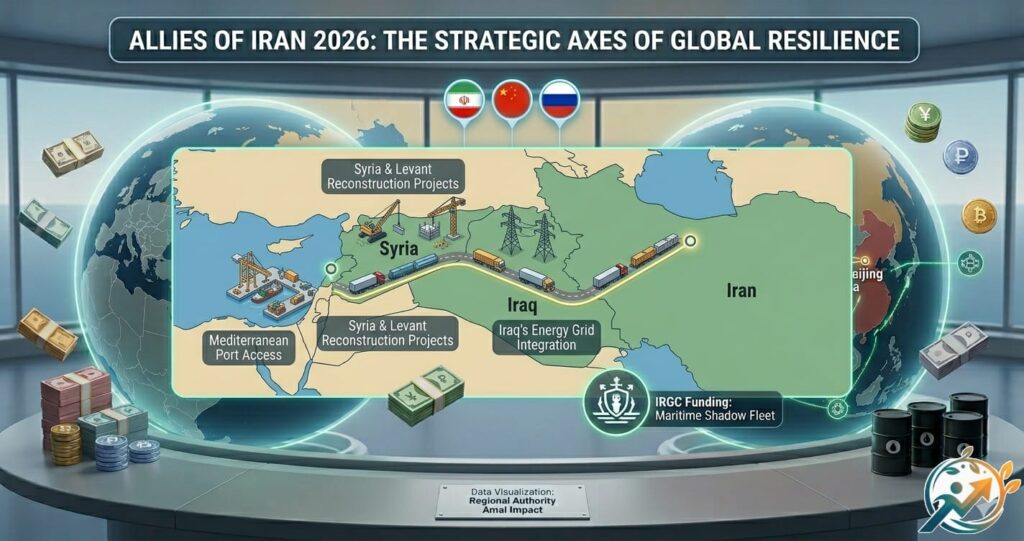
- Iraq’s Strategic Utility: Iraq remains one of the most vital Allies, serving as a financial lung for Tehran. By relying on Iranian gas to power its grid, Iraq creates an economic dependency that provides Tehran with massive political leverage.
- The Resistance Axis Economy: From Syria to Yemen, the regional Allies have established a mutual-aid network. This allows for the swapping of essential resources like fuel, grain, and medical supplies outside the traditional global market, ensuring the survival of Tehran’s most loyal partners.
6. Global Economic Fallout: The “Iran Factor” in 2026 Markets
The strengthening of the axis of the Allies of Iran 2026 has direct, tangible consequences for consumers in North America and Europe.
Coordinated Energy Volatility
The strategic coordination between the Allies of Iran 2026 means they have the collective capacity to influence global oil and gas prices. For the West, this translates into persistent inflation and energy supply uncertainty. A simple military exercise by the Allies of Iran 2026 in the Strait of Hormuz can trigger an immediate 10-20% spike in global energy costs.
Maritime Security Chokepoints
With advanced anti-ship technology provided by their global partners, the Allies of Iran 2026 now possess the ability to disrupt global supply chains at will. This makes the Allies of Iran 2026 a primary driver of the rising costs in international shipping and maritime insurance, impacting everything from electronics to raw materials.
7. The 2026 Outlook: Resilience through Alliances
As we look toward the remainder of 2026, it is clear that the strategy of relying on the Allies of Iran 2026 has provided Tehran with a level of resilience once thought impossible.
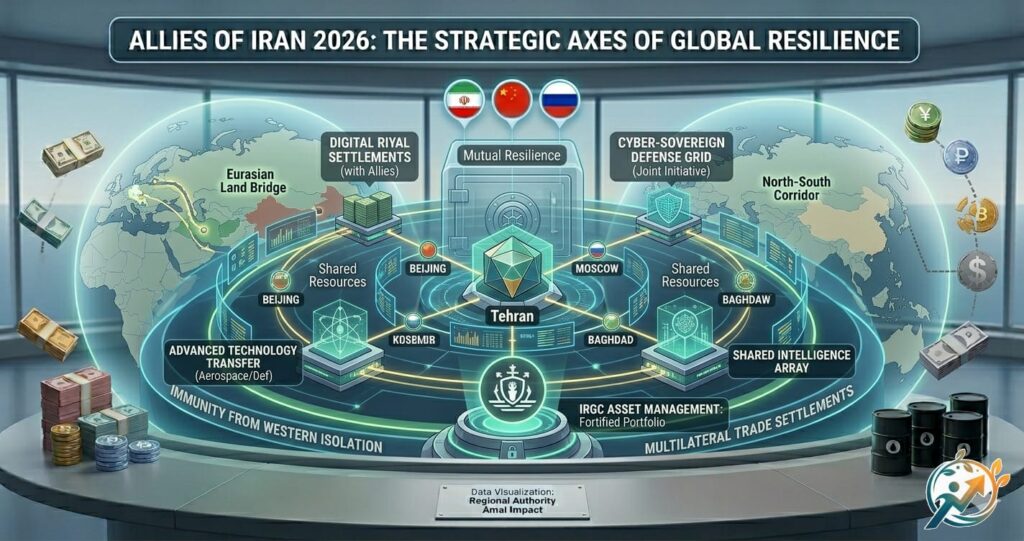
- Joint Digital Currency: Analysts expect the Allies of Iran 2026 to launch a unified digital trade currency by the end of the year to further decouple from the US financial system.
- Cyber and Nuclear Readiness: The acceleration of technology transfers between the Allies of Iran 2026 has brought Iran to a new threshold of strategic readiness, making traditional diplomatic “red lines” increasingly irrelevant.
The New Reality for Amal Impact Readers
The era of a solo, isolated Iran is over. The Allies of Iran 2026 have created a new geopolitical reality that demands a total reassessment of global strategy. For the audience of Amal Impact staying informed on the shifts within the network of the *Allies of Iran 2026 is the only way to navigate the volatile landscape of the modern world. The strength of this axis lies in its ability to turn external threats into opportunities for deep, systemic integration.