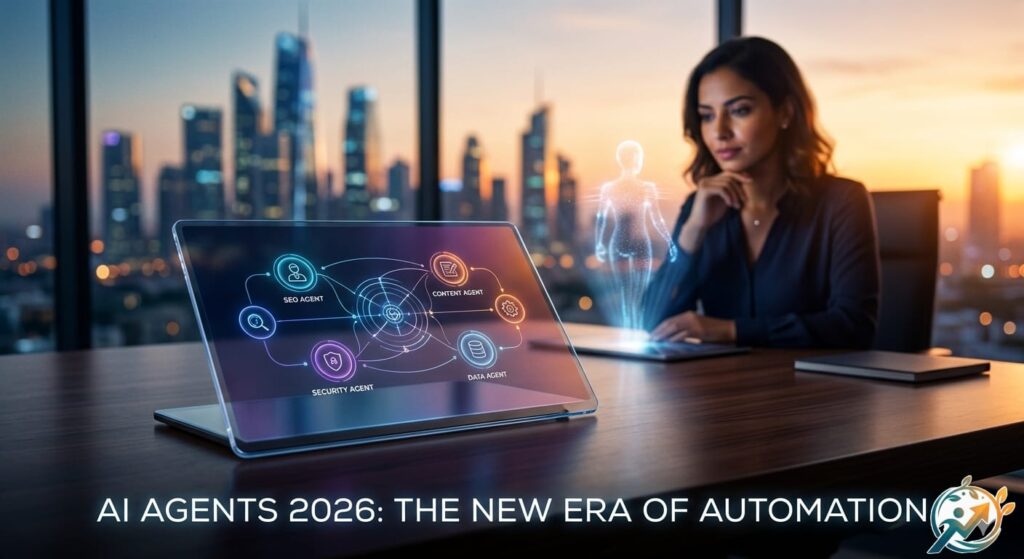

In the rapidly evolving digital landscape of 2026, the conversation has shifted from simple chatbots to the profound capabilities of AI Agents. While early generative AI focused on responding to prompts, modern AI Agents are designed to execute complex tasks independently. Consequently, understanding this transition is no longer optional for tech professionals; it is a fundamental requirement for staying competitive in a world driven by autonomous systems.
What is an AI Agent? Defining Autonomy
To begin with, we must define what makes an “agent” different from a standard AI tool. A traditional AI, like a basic LLM, requires a human to provide a prompt for every single action. However, an AI Agent operates with a degree of agency. It is given a high-level goal—such as “optimize my website’s SEO performance”—and it proceeds to break that goal into smaller sub-tasks without further human intervention.
These agents possess four core characteristics:
- Perception: They monitor their environment (your website, market trends, or databases).
- Reasoning: They analyze data to make strategic decisions.
- Action: They execute tasks, such as updating code or sending emails.
- Learning: They refine their future actions based on previous successes or failures.
The Architecture of Modern AI Agents
Understanding the “brain” of an AI agent is crucial for anyone looking to implement them. Most agents in 2026 are built on a framework that includes a “Reasoning Engine” and a “Memory Module.”
Moreover, the integration of “Long-Term Memory” allows these agents to remember a user’s specific preferences over months of interaction. For instance, if an agent is managing your digital portfolio, it learns the specific visual aesthetic you prefer for your brand. Therefore, the more you interact with the agent, the more efficient and personalized its outputs become.
How AI Agents are Transforming Digital Strategy
The impact of AI agents on digital strategy is monumental. In the past, a web developer had to manually configure plugins, monitor SEO metrics, and draft content. *Nowadays, AI agents act as “Digital Project Managers.” They can audit a site like *AmalImpact.com, identify ranking gaps, and autonomously generate 1250-word articles that meet every “green” SEO metric.
1. Autonomous SEO and Content Creation
SEO is perhaps the domain most affected by agency-based AI. Agents can now perform real-time keyword research and immediately update meta descriptions or titles that exceed character limits. Furthermore, they can analyze the “Flesch Reading Ease” of an article and automatically insert transition words to ensure the content is accessible to a wider audience.
2. Streamlined Client Acquisition
For tech professionals seeking premium clients, AI agents serve as the ultimate “Visual Gateway.” An agent can scan LinkedIn or tech forums to identify high-value leads and then customize a portfolio presentation specifically for that lead’s industry. As a result, the time spent on administrative “cold reaching” is reduced to nearly zero, allowing creators to focus on the actual work.
The Technical Challenges: Security and Ethics
Despite the clear benefits, the adoption of AI agents comes with significant challenges. In particular, the issue of “Agentic Loop Overlap” can occur when two different agents attempt to optimize the same system with conflicting goals. This is similar to having two different SEO plugins active on a single WordPress site; it leads to confusion and performance degradation.
Additionally, data privacy remains a top priority. Because agents require access to sensitive databases to function autonomously, ensuring they operate within a “Zero-Trust” security framework is vital. Organizations must implement strict guardrails to prevent agents from making unauthorized financial transactions or leaking proprietary strategies.
Practical Implementation: Working with AI Agents
If you are looking to integrate AI agents into your workflow today, the process should be handled in stages.
- Stage 1: Observation. Allow the agent to monitor your current workflow and suggest optimizations.
- Stage 2: Assisted Action. Let the agent draft emails or code snippets, but require human approval before they are published.
- Stage 3: Full Autonomy. Once trust is established, the agent can handle routine tasks, such as background image manipulation or temporal updates on documentation, entirely on its own.
The Future of AI Agents in 2026 and Beyond
Looking ahead, the line between “software” and “employee” will continue to blur. We are moving toward a “Multi-Agent System” (MAS) model where specialized agents—one for SEO, one for Graphic Design, and one for Coding—communicate with each other to complete a project.
Consequently, the role of the human professional is shifting from “doer” to “orchestrator.” Instead of writing every word of a 1250-word article, the professional will define the “intent,” and the AI agents will handle the execution, ensuring every technical detail is perfect.

Transitioning to an Agentic Workflow
To successfully transition, one must embrace the “Strategic Mindset.” This involves moving away from micro-management. If an agent alerts you that your headline has “Too Many Words,” you should trust its data-driven analysis. In addition, using tools that offer “Headline Analyzers” or “Sentiment Analysis” can help you understand why an agent is making certain recommendations.
The ultimate goal is to create a seamless synergy. When your AI agent manages the “Readability” and “Transition Words,” and you provide the “Creative Vision” and “Emotional Depth,” the resulting output is far superior to what either could achieve alone.
Embracing the Autonomous Future
In conclusion, AI agents represent the most significant leap in productivity since the invention of the internet. They are not merely tools; they are autonomous partners capable of managing the complexities of the 2026 digital economy. By mastering the use of these agents, you ensure that your projects—from website development to premium client acquisition—are handled with a level of precision and efficiency that was previously unimaginable.
Therefore, the question is no longer whether you will use AI agents, but how effectively you will lead them. As we continue to refine our SEO strategies and content structures, these autonomous systems will be the backbone of every successful digital impact.


👍👍👍